
Blog
Wabi-Sabi Wall Art in Australia: A Buyer’s Guide

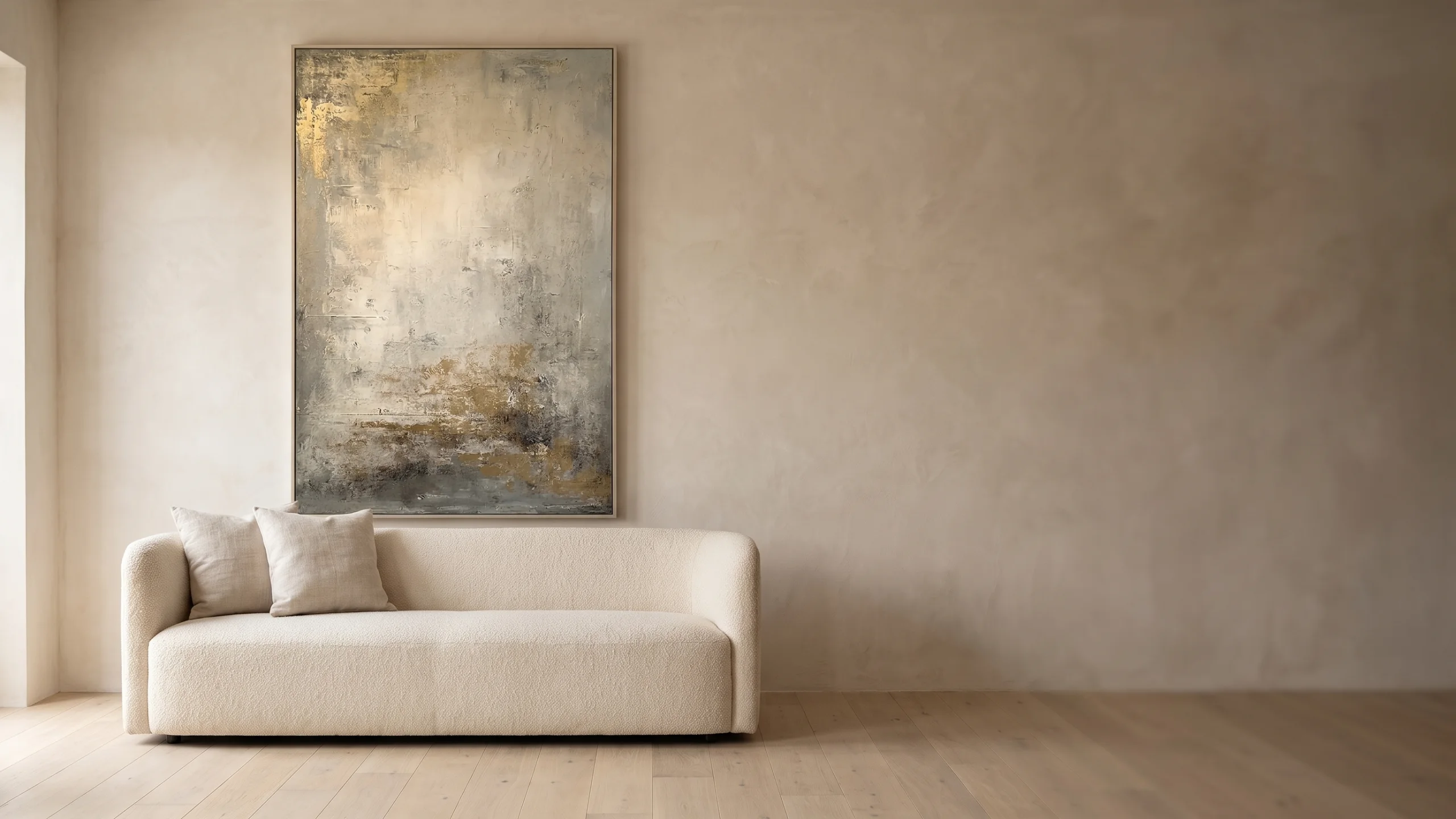
Wabi-sabi wall art is art built on the Japanese idea that beauty lives in imperfection, age and incompleteness. In practice that means muted, earthy colour, visible texture, uneven edges and marks left by the maker’s hand. In Australia it is most often sold as textured canvas worked in plaster, clay or heavy impasto. A large share of what is advertised as wabi-sabi art is a printed photograph of texture rather than texture you can feel.
That last point is worth slowing down on, because it is where most money gets wasted. This guide covers what the style actually is, how to spot a genuinely textured piece, and what to check before buying in Australia.
What makes a piece wabi-sabi rather than just minimalist
Minimalism removes things. Wabi-sabi keeps the evidence of how something was made.
A minimalist canvas aims for a clean, resolved surface. A wabi-sabi piece leaves the ridge where the palette knife stopped, the hairline crack in a plaster passage, the place where one colour was dragged over another before it had dried. Those marks are the subject of the work.
Three qualities show up in almost every genuine example.
- Restrained colour. Bone, chalk, clay, oatmeal, charcoal, rust. Colour that looks weathered.
- Real relief. Surface you could read with your eyes shut: raised ridges, troughs, grit.
- An unresolved edge. Areas left bare, a composition that stops rather than concludes.
A piece with muted colour and a flat, even surface is minimalist décor borrowing the palette. That is a perfectly reasonable thing to buy. It should not carry the price of an original.
Why so much wabi-sabi art sold online is printed
Texture photographs beautifully. A high-resolution photograph of a plaster painting, printed onto canvas, looks almost identical to the original in a product shot taken straight on under soft light. It costs a fraction to produce and can be sold in unlimited quantity.
That is why the category fills up with near-identical pieces across dozens of unrelated stores, and why listings so often avoid close-up photographs taken from an angle.
There is nothing wrong with buying a print. The problem starts when a print is described as handmade, original or one-of-a-kind, or priced as though it were.
Three ways to tell real texture from a printed effect
You can do all three from a product page, before you spend anything.
| What to check | Genuine texture | Printed effect |
|---|---|---|
| Raking light. A photo lit from one side, low across the surface | Ridges cast real shadows that shift across the piece | Shadows are baked into the image and stay flat |
| The edge of the canvas | Medium wraps or stops unevenly, with visible build-up at the sides | The image continues neatly around the edge, or the sides are blank white |
| Repetition across listings | Every piece differs. No two photographs are identical | The same image turns up on other stores, sometimes mirrored or recoloured |
The most useful thing you can ask any seller for is a photograph taken with light raking across the surface from the side. A textured original is unmistakable under that light. A print has nowhere to hide. If a seller will not provide one, you have your answer.
Our guide on how to tell if a painting is hand-painted or a print goes through more tests in detail.
Choosing size for an Australian home
Wabi-sabi work is quiet. Hung too small, it disappears into the wall.
For a piece above furniture, aim for roughly two thirds the width of whatever sits beneath it. Above a standard three-seater sofa that usually means a single piece around 100cm to 140cm wide, or a pair.
Two things about Australian homes are worth naming. Open-plan living areas have longer sightlines than the rooms these pieces are usually photographed in, so the work often gets viewed from six or seven metres rather than two. That argues for going larger than feels comfortable on screen. Bright overhead light through the middle of the day also flattens subtle relief, so texture reads best on a wall that catches raking morning or late afternoon light.
Our guide to hanging height above a sofa covers placement properly.
What to check before you buy in Australia
- Is it made to order, and how long does that take? Hand-finished work is usually painted after you order. A stated lead time is a good sign. Instant dispatch on a one-of-a-kind piece is not.
- Can you see the piece before it ships? No two originals are identical, so the one you receive will not be the one photographed on the listing.
- How is it stretched? A rolled canvas arrives as a tube and still needs stretching, which is an added cost most listings leave out.
- What happens if it is wrong for the room? Colour and scale are hard to judge on a screen. Check the returns window and who pays the freight.
- Is shipping insured? Textured surfaces are far more vulnerable in transit than a flat print.
Frequently asked questions
What is wabi-sabi wall art?
Art built on the Japanese aesthetic of finding beauty in imperfection, age and incompleteness. It is characterised by muted earthy colour, visible surface texture, uneven or unfinished edges, and evidence of the maker’s hand.
Is wabi-sabi art the same as minimalist art?
No. Both use restrained colour. Minimalism aims for a clean resolved surface, while wabi-sabi deliberately keeps the marks, cracks and irregularities that show how the piece was made.
How can I tell if wabi-sabi art is hand-painted or printed?
Ask for a photograph lit from the side, low across the surface. Real relief casts shadows that shift across the piece. A printed texture stays flat. Also check the canvas edges, and search whether the same image appears on other stores.
What size wabi-sabi piece should I buy?
Aim for roughly two thirds the width of the furniture beneath it. Above a three-seater sofa that is usually a single piece around 100cm to 140cm wide, or a pair. In open-plan Australian homes, size up rather than down.
What colours work with wabi-sabi wall art?
Bone, chalk, oatmeal, clay, charcoal and rust. The palette is deliberately weathered, which is why it sits comfortably with natural timber, linen, stone and unpainted plaster.
Does wabi-sabi art suit a small room?
Yes, as long as the piece is not shrunk to match. One larger textured work reads calmer in a small room than several small pieces, which create clutter and work against the aesthetic.
Seeing it in person
Every piece in our wabi-sabi wall art collection is painted by hand to order and never printed. We ship free and fully insured across Australia and the United States, and we photograph each piece and send it to you for approval before it leaves the studio, so you see the actual work rather than a sample image.
If you want to understand the aesthetic itself first, start with what wabi-sabi wall art is.
