
Blog
How to Tell if a Painting Is Hand-Painted or a Print (Without Being an Expert)

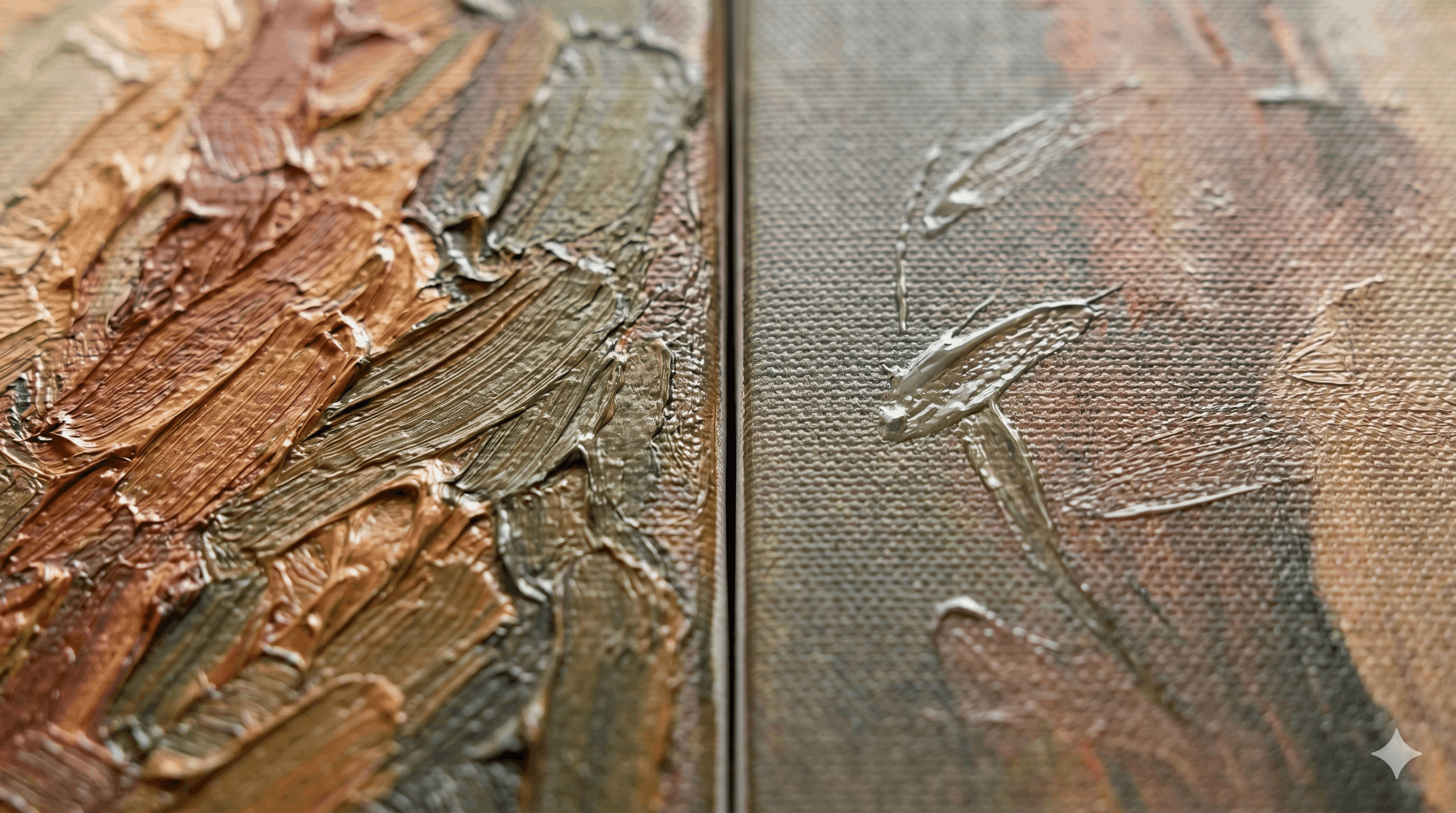
You can tell a hand-painted canvas from a print with three checks. Brushstrokes should change direction and thickness across the surface. Texture should vary — thick in some passages, thin in others. And on the back, paint should wrap unevenly around the stretcher bars. A print has a uniform surface, repeating texture, and a clean machine-cut edge.
Here's something the wall art industry would rather you didn't know, and at Monavoart we'd rather you did: a lot of what gets sold as "art" online is a printed image on canvas with a few brushstrokes added on top to make it look hand-painted. It's called an "embellished print," and it's often priced like an original.
If you're spending $300 or more on a piece for your home, you should know what you're actually buying. This guide is the closest thing to a thirty-second test you can do — even on a phone screen, before the painting ships.
The three things to look for
1. Brushstroke direction
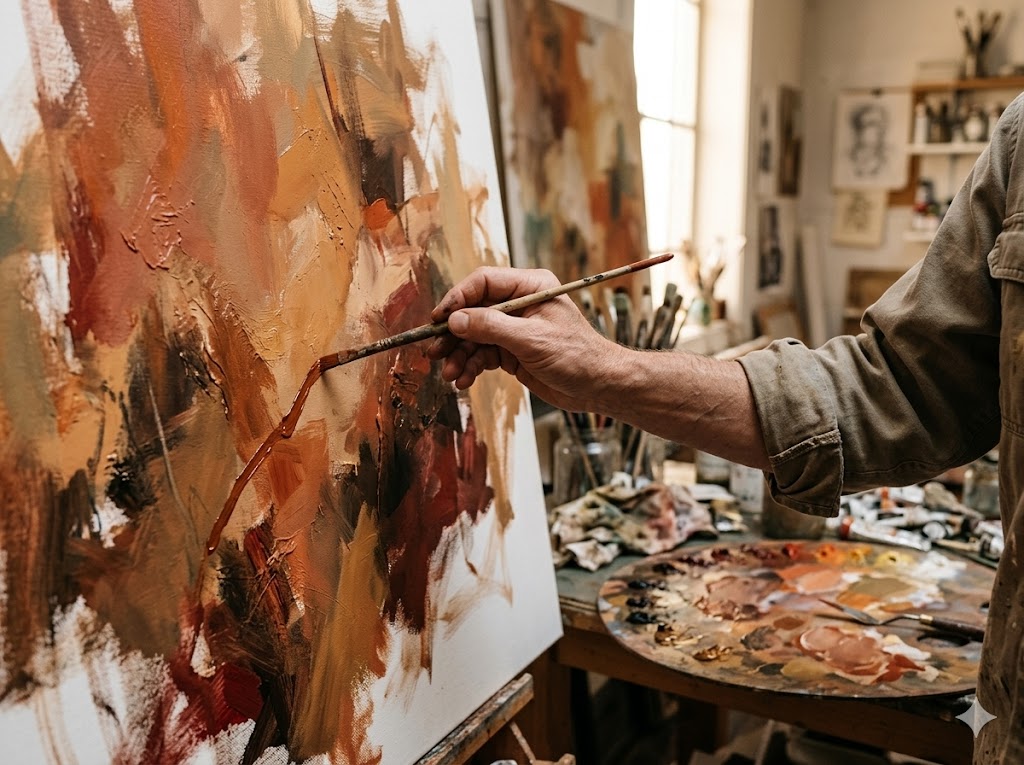
In a real hand-painted piece, the brushstrokes go in different directions across the canvas — because a human hand was painting a human composition. The strokes follow the form. A painted leaf has strokes flowing along the leaf's curve. A painted sky has horizontal strokes. If you ever look closely at a Van Gogh in person at somewhere like the Met, this is exactly what you see — every stroke moving with intention.
In a print, even an embellished one, the underlying image is uniform. You'll see the brushwork sitting on top of an image rather than being the image. If you zoom into a product photo and the brushstrokes all run roughly parallel, or only appear in certain spots, you're probably looking at a print. As a rule at Monavoart, we always include high-resolution close-ups on our original paintings collection exactly so you can do this check before buying.
2. Texture variation
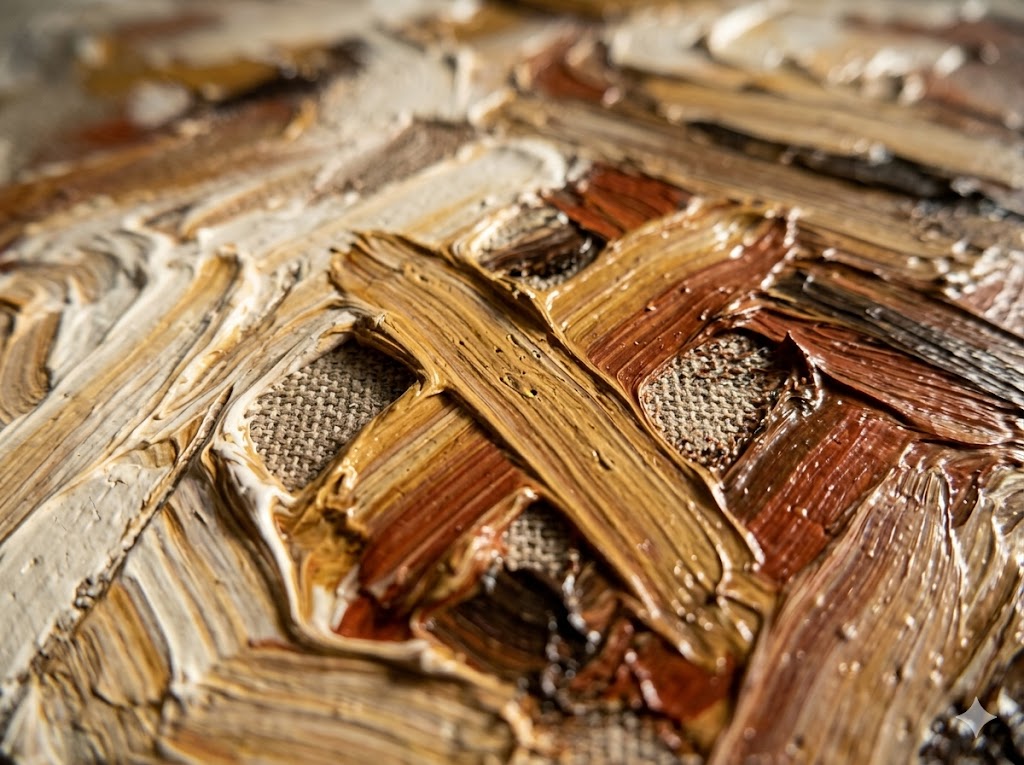
Run a finger across a real oil painting (gently) and you'll feel ridges. Some thick, some thin, some smooth, some sharp. The texture is irregular because paint was applied in layers over hours or days.
A printed canvas has a uniform texture — usually the texture of the canvas weave itself, which is the same across the whole surface. Embellished prints add a thin layer of clear gel or a few visible strokes, but the rest of the canvas stays flat. If a seller's product photos never show a side angle of the painting, that's often why. At Monavoart we deliberately photograph every original at an angle so you can see the actual paint thickness.
3. The back of the canvas
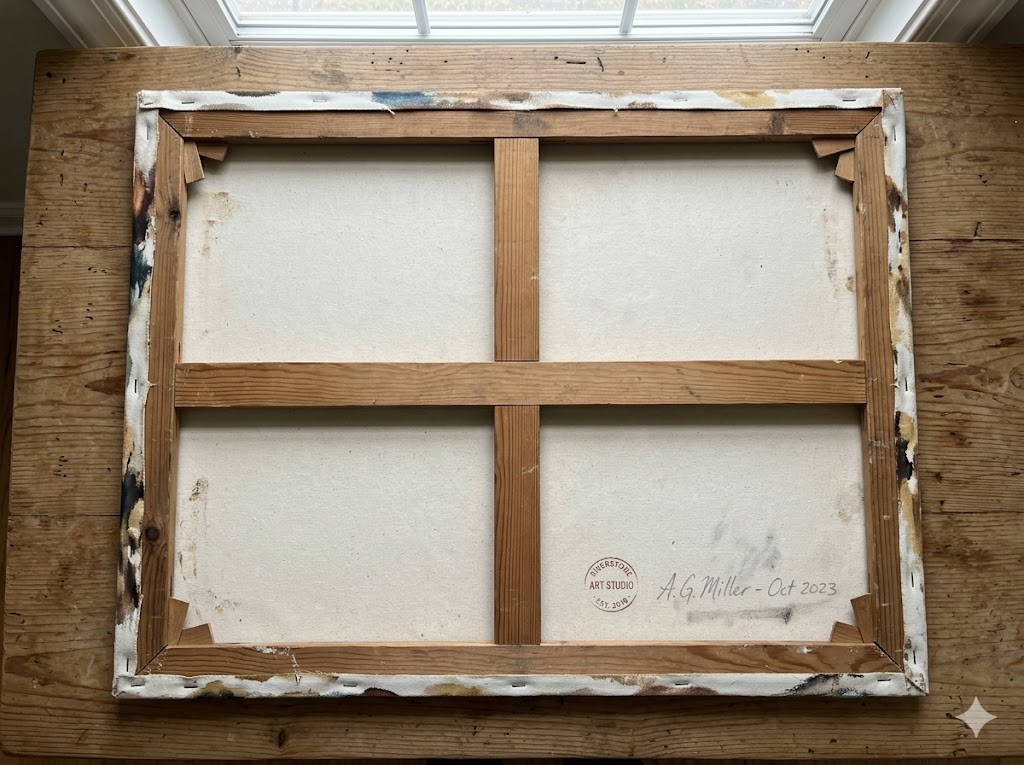
This one's the giveaway. Ask the seller for a photo of the back of the painting before you buy.
A real hand-painted canvas usually shows:
- Paint bleed-through at the edges where the artist worked thickly
- A signed and dated back, often with the title
- Sometimes a stamp or stretcher mark from the artist's studio
- Visible wood stretcher bars (real ones, not stapled-on MDF)
A print on canvas has a clean, uniform back with no bleed-through, often with a barcode sticker or a manufacturer's label. If the seller refuses or dodges this request, that tells you something on its own. If you ever ask for a back-of-canvas photo at Monavoart, we'll send it the same day — every piece in our catalog is signed by the artist who painted it.
The three checks at a glance
| Check | Hand-painted | |
|---|---|---|
| Brushstroke direction | Changes across the canvas; strokes start and stop in different places | Uniform direction, or a pattern that recurs at intervals |
| Texture variation | Genuinely raised in places, thin in others | Flat, or an even embossed pattern of the same depth throughout |
| Back of the canvas | Paint wraps around the stretcher unevenly; edges irregular | Clean, machine-cut edge; image stops precisely at the fold |
| Under raking light | Shadows move as you move | Nothing changes |
What about "limited edition prints"?
Limited edition prints are a legitimate category — and they can be valuable. A signed, numbered print from an established artist (let's say 1/50, signed in pencil) is a real collectible. That's not what we're talking about here.
The problem is when a mass-produced canvas print gets marketed using language that sounds like an original. Watch out for phrases like "gallery-quality reproduction," "artist-enhanced canvas," or "studio print with hand-finishing." These are all prints. They might be lovely prints, but they're not originals, and they shouldn't be priced like originals.
Why this matters at the $300+ price point
Under $100, you're almost certainly buying a print, and that's fine — prints have their place. Between $100 and $300, the market is mixed and a lot of buyers get confused. Above $300, you should be getting an original, full stop. If a seller is asking original-painting prices for a print, walk away.
A real hand-painted oil or acrylic original takes a working artist somewhere between 8 and 40 hours depending on size and complexity. Add materials, shipping, the gallery's cut, the artist's cut, and you start to understand why originals cost what they cost. A $400 original is genuinely affordable for the labor involved. A $400 print is overpriced.
A few honest caveats
We don't want to be too absolute about this at Monavoart. Some sellers are upfront that they sell prints and price them fairly. Some artists deliberately work in editions because it makes their work accessible to more people. None of that is dishonest.
What's dishonest is the in-between zone — sellers who use original-painting language and original-painting prices for what is essentially a printed reproduction. That's the practice this guide is meant to help you spot.
How Monavoart approaches this, and why
We'll be transparent about our model since it's relevant to the topic: every piece on Monavoart is a hand-painted original, sourced directly from working artists in China. China has an extraordinary fine-art painting tradition that most American buyers never encounter, partly because the supply chain has historically routed through galleries that mark up 4-6x.
At Monavoart we work directly with the artists, which is how a genuine 48-inch original oil painting can land at $400-$600 instead of $2,000+. The artwork is real. The artists are real. The brushstrokes go in different directions. And the backs of our canvases are signed.
If you ever want a back-of-canvas photo before you buy, browse our original hand-painted collection and just ask us. We'll send it.
If you've been burned by an embellished print before, you're not alone — at Monavoart it's one of the most common stories we hear from new customers. The market is messier than it should be. Knowing the three things above puts you ahead of most buyers.
Frequently asked questions
How can I tell if a painting is hand-painted or a print?
Check three things: whether brushstrokes change direction and thickness, whether texture varies across the surface, and whether paint wraps unevenly around the back of the stretcher. Then hold a light at a low angle — on a hand-painted canvas the shadows move; on a print nothing changes.
What is an embellished print?
An embellished print is a printed image on canvas with brushstrokes added on top by hand to make it look like an original. It is legal to sell, but it is often priced like an original painting, and the underlying image is still a reproduction.
Is a limited edition print an original painting?
No. A limited edition print is a reproduction produced in a capped quantity. The cap affects scarcity, not originality — the image was printed, not painted.
Does it matter whether art is hand-painted or printed?
Below about $100 it usually does not; you are buying a look. Above roughly $300 it matters a great deal, because at that price you are paying original-artwork prices and should be receiving an original artwork.
Can you tell from a photograph online?
Not reliably. Look for close-up photographs taken at a low angle that show the texture edge, and for images of the back of the canvas. Genuine originals also vary slightly between pieces — if every photograph of the same artwork is identical, it is a reproduction.
Do Monavo pieces come with proof they are hand-painted?
Every piece is painted to order and photographed for your approval before it ships, and a certificate is included. If it is not what you expected in your space, returns are free for 30 days.

About Monavo Art Studio
Monavo Art Studio makes original textured and wabi-sabi wall art, painted by hand to order and never printed. We write about how this work is actually made, how to tell a hand-finished piece from a printed reproduction, and how to choose scale and placement for Australian homes. Every piece is photographed and sent to the buyer for approval before it leaves the studio.
View all posts by Monavo Art Studio